
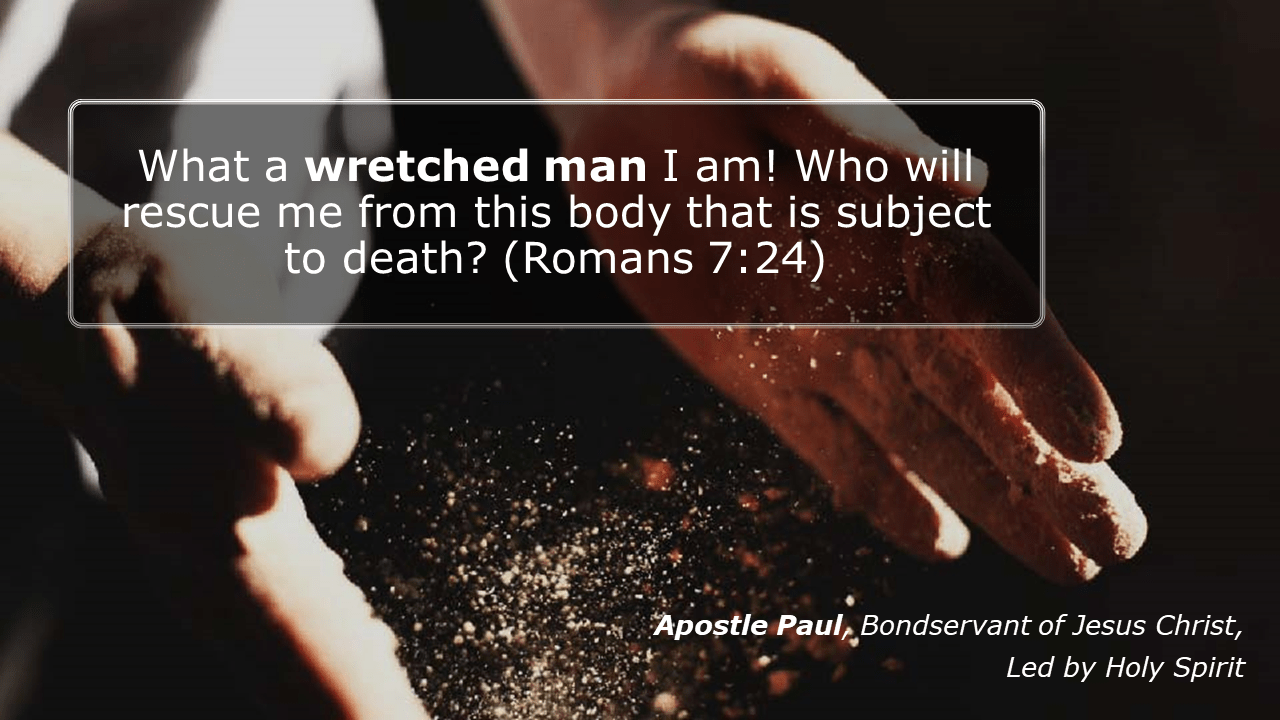
How often have I walked away from a conversation and asked myself why I said a particular thing, or why I didn’t exercise more restraint? It is clear that I have grown in my walk with the LORD, but it is even more apparent that my heart and mind still require so much more refining. I can wrestle with something longer than I would like to (which can be frustrating). Have you ever been there? This internal struggle is one of the reasons I enjoy Romans 7.
Chapter 7 has a central theme of FREEDOM FROM THE CONDEMNATION OF THE LAW. Praise God for that! Can I absorb what that means to the point of walking in victory consistently? Maybe not consistently, but certainly progressively. The Holy Spirit uses the Apostle Paul’s transparency to comfort all believers about the struggle with imperfection.
Some understand Christian freedom but then abuse it through an overly permissive lifestyle that does not glorify God (which is sinful and not of the Holy Spirit). Others want to press on in advancing in Christlikeness and become frustrated when falling short. This ‘free but struggling’ concept is difficult to comprehend because the words seem contradictory. In some instances, every believer must be conflicted between two natures (just like Paul admitted at the end of Chapter 7).
How can I be dead to sin but have these innate flaws? When will I learn to more promptly hush the accusations with the truth of God’s Word? If I know I have the power to deny myself, why don’t I do it?
Because Scripture is God-breathed, be assured that the Heavenly Father who loves us so very dearly wants His beloved believer to know that while we feel the battle between the natural and the regenerated natures, we are indeed free from the damnatory sentence resulting from violating the perfect law of God.
In this chapter, the word ‘law; is mentioned 23 times, and the word ‘sin’ is used 16 times (depending on the translation version). The question that readily comes to mind is: how can anyone feel free from condemnation with such a focus on the law and sin?
Well, that’s just it. It’s not about feelings. Feelings can lie. The good news is that the Holy Spirit confirms in Romans 7 that through union with Christ, the believer is free from the accusation even though the struggle with sin is real! It seems to me, the closer you get to the LORD, the more you see your unholiness and the more you realize how much you are truly loved (despite the work still in progress)!
Here’s the Background:
I’ve included links to prior study blogs should you wish to review them. If not, just move past this section.
The first 3 chapters of Romans defined the sin problem for all humans. The last part of chapter 3 and chapter 4 explained that being pardoned (justified by God’s grace through faith in Christ) is the only way to have access to God. In Chapter 5, the headship of Adam was contrasted to the headship of Christ demonstrating the failures of human nature and the perfection of God’s righteousness. The evident solution is to allow God’s grace to reign over one’s life through faith in Christ. With the concept of ‘justification imputed through Christ, received by faith, and resulting in fruits of righteousness’ having been fully explained in chapter 5, the reader should have gained a solid foundation about the transaction that occurred when faith was born in their hearts.
Romans 6 dealt with sanctification which is the Holy Spirit imparting righteousness in the heart of the believer. So, while in one sense sanctification has been received for every believer without deeds or performance at the moment God declared them pardoned (or justified), there is also ongoing sanctification in the believer’s training on earth before being glorified; this requires the believer’s participation. When a person places full reliance on Christ for sin, Christ’s righteousness was imputed (put on the believer’s account) which set them apart from the rest of the world. Next, the believer continues to cooperate with the Holy Spirit in putting more distance between the ways of the world and more proximity to Christ. Since Christ provided freedom for sin’s tyranny, we are with increasing measure to (1) know what Christ’s finished work accomplished; (2) reckon or count ourselves dead to sin; (3) yield to the empowerment and leading of the Holy Spirit; and, (4) we are to obey.
This was Christ’s prayer for believers. With the background summarized, let’s direct our concentration to Romans 7.
Outline:
- Widowed and Remarried (Romans 7:1 to 6): In this section, we will understand how union with Christ delivered us from the guilty verdict of the law because of death. This section is key to navigating the remaining passages that deal with the dichotomy between the new creation person and the old human nature that still exists (hopefully increasingly in dormancy).
- Why Do I Do That? Because the Struggle is Real! (Romans 7:7 to 25): In this section, we will appreciate the process of sanctification and see what God is doing in it. When this passage is understood, the believer can enjoy so much freedom! In the section, the contrasts are made clear:
- Verses 7 to 13 relate to the pre-converted person and provides the purpose of God’s Law. Paul reflected on his experience. For the believer, this is past tense.
- Verses 14 to 20, take us into the present tense of the believer’s walk of sanctification. Paul confesses his regenerated heart delights in God’s law whereas his humanity still has a modus operandi. There are contrasts between the principles at work in each nature.
- Verses 21 to 25 give us the conclusion of the struggle which (1) solidifies the impact of the monergistic finished work of Christ forever, and (2) reminds us that God’s work in us is ongoing in a synergistic way. This is not a debate between Calvinism and Arminianism; it is just biblical.
- The Struggle May Be Real, But the Union is Greater! (Romans 7:25 to Romans 8:4): In this very short but sweet section, we see that the struggle weakens; and, both the cause and effect of the diminishment are worth it! There is a synergistic application for us here!
Grab your Bible and let’s dive into the water of the Word to be refreshed by its purifying and refreshing power!
Widowed and Remarried (Romans 7:1 to 6)
In this passage, the Holy Spirit led Paul to remind the believers of a basic truth that no one living in civilization would argue. He starts by saying:
- “Or do you not know, brethren (for I speak to those who know the law), that the law has dominion over a man as long as he lives?” (Romans 7:1).
I suppose some people think they are above the law or hope to avoid consequences, but even if they seem to escape judgment under human laws, ultimately every human being will give an account for their actions. Jesus said:
- “But I say to you that for every idle word men may speak, they will give account of it in the day of judgment.” (Matthew 12:36).
It is also written that:
- “.. there is no creature hidden from His sight, but all things are naked and open to the eyes of Him to whom we must give account.” (Hebrews 4:13).
Paul was addressing believers who (1) knew the law; (2) had been pardoned; and,(3) were living under Roman rule. Hmmm. Yet, Paul stated, “Or do you not know”. The verse starts with a conjunction between connected thoughts. So, let’s return to the previous verses for context. He said:
- “But now having been set free from sin, and having become slaves of God, you have your fruit to holiness, and the end, everlasting life. For the wages of sin is death, but the gift of God is eternal life in Christ Jesus our Lord.” (Romans 6:22 to 23).
So, we see that Paul made a connection between:
- the past transaction of being pardoned (set free from the penalty of sin); and,
- the current position of being a bondservant to fully serve God’s purposes (which results in being holy and eternal life).
He was clearly saying that the law has authority over a person (saved or otherwise) as long as someone is breathing. Don’t worry Christian friend; Paul later explains this in Romans 8.
There are different laws for different jurisdictions but we aren’t in chapter 8 just yet. But as a sneak peek, consider this verse. It is written:
- “For the law of the Spirit of life in Christ Jesus has made me free from the law of sin and death.” (Romans 8:2).
For now, let’s remain calm and carry on with Roman 7, verse 1. The word “dominion” used here in the Greek text is “kyrieúō” (Strong’s G2961) which means “to be lord of or rule over” and the root word is “kýrios” (Strong’s G2962) which is used for a person exercising absolute ownership rights; lord (Lord). This is the same word that Paul uses in Romans 14 which quotes Isaiah 45:23.
- “For it is written: “As I live, says the LORD, Every knee shall bow to Me, And every tongue shall confess to God.” (Romans 14:11).
When Paul quoted Isaiah 45:23, he referred believers back to the remembrance of the Lordship of Yᵉhôvâh (Strong’s H3068), the self-Existent or Eternal; Jehovah, the Jewish national name of God; the Lord. The entire 45th chapter of Isaiah explains that there is only one Sovereign God and that the earthly rulers are merely servants of His will (whether they know it or not). The chapter concludes by referring to a time in humanity’s future where He will reign over all.
So then, let me ask you this. Is it true that the law has power over every human? Absolutely.
There are universal laws that apply to all living on earth whether human beings wish to acknowledge them or not.
- There are laws of physics that are continually being discovered as humanity grows in knowledge.
- There is also natural law. “In jurisprudence and political philosophy, a system of right or justice common to all humankind and derived from nature rather than from the rules of society, or positive law.” This is cited from Britannica, The Information Architects of Encyclopaedia. Encyclopedia Britannica, 30 Apr. 2023, https://www.britannica.com/facts/natural-law.
- Then there are the jurisdictional laws and religious laws; etc.
So regardless of beliefs, there will be some sort of law that humanity is subject to.
Now, for most believers, if we do not accept Romans 7:1 as a simple truth and fail to read further, this may get someone’s back up because it sounds contrary to what we know about being free in Christ (but it is not).
Paul went on to explain what Christ did at the cross.
- “For the woman who has a husband is bound by the law to her husband as long as he lives. But if the husband dies, she is released from the law of her husband. So then if, while her husband lives, she marries another man, she will be called an adulteress; but if her husband dies, she is free from that law, so that she is no adulteress, though she has married another man.” (Romans 7:2 to 3).
This is where many people who enjoy debate get sidetracked by the argument of divorce and remarriage. Both Paul and Jesus spoke about divorce, but Paul did venture there in his letter because that discussion had nothing to do with the doctrine he was explaining.
The point is that death resolutely concludes or ends a person’s connection to the law they were under. Law has no impact on the dead.
Upon being pardoned, a believer is:
- released from the law’s rightful penalty and hold;
- transferred by a new birth into the realm of the King’s royal court; and,
- married into the household of His Majesty on High, Jesus (the Christ).
His Sovereign provides the full pardon and a new life begins under the authority of the Sovereign. It is written:
- that you may be filled with the knowledge of His will in all wisdom and spiritual understanding; that you may walk worthy of the Lord, fully pleasing Him, being fruitful in every good work and increasing in the knowledge of God; strengthened with all might, according to His glorious power, for all patience and longsuffering with joy; giving thanks to the Father who has qualified us to be partakers of the inheritance of the saints in the light. He has delivered us from the power of darkness and conveyed us into the kingdom of the Son of His love, in whom we have redemption through His blood, the forgiveness of sins. (Colossians 1:10 to 14).
A pardon is part of the legal system, and it does not negate the law; it simply applies a privilege that the legitimate authority has a right to exercise. This does not mean that the law was bad or no longer exists. It also does not mean that a person was innocent of breaking the law.
For Christians, God’s pardon means that the pardoned believer has been given ambassadorial immunity from the law; and, that Christ’s righteousness has been imputed. In the heavenly books, the pardoned person’s record notes that the price was paid in full by the shed blood of the worthy Lamb of God, the only sufficient Substitute.
In Romans 7:3, the word “free” in the Greek text is “eleutheros” (Strong’s 1658) which means “not a slave, or not under restraint”. It is used as being delivered from obligation. Since God’s law does not go away, the one who has remarried to the LORD is now exempt from the penalty of sin and the law and is unrestrained in their freedom from the law within the new union as the bride of Christ, a regenerate child of God. Jesus said:
- … “If you abide in My word, you are My disciples indeed. “And you shall know the truth, and the truth shall make you free.”… “Therefore if the Son makes you free, you shall be free indeed.” (John 8:31 to 32 and 36).
It is also written:
- “Stand fast therefore in the liberty by which Christ has made us free, and do not be entangled again with a yoke of bondage.” (Galatians 5:1)
Sin and legalism are both yokes of bondage; like two sides of the same coin. So, we pray as the Psalmist did:
- “Direct my steps by Your word, and let no iniquity have dominion over me.” (Psalm 119:133).
Paul used the picture of “marriage” in this passage. The concept of being under the bonds of matrimonial law communicated what our union with Christ accomplished beyond the pardon.
In years past, it was common to use words such as “for as long as we both shall live” in making the marriage covenant. I wonder how many Christians understand their marriages are united to fellowship with Christ and are a reflection of the blessed Godhead. Christian marriage is so much more than a legal contract; it is a covenant. A covenant remains a walk of faith and commitment from one’s old life into a new life (a death to independence and a new birth into oneness). Certainly, the individuals remain distinct and equal; but, they now exist together in harmony for the union; and together, they decide on actions that benefit the union which may include giving preference to one individual’s desires above their own. When one triumphs against external adversity or challenge, everyone in the union wins; when one wins an internal battle against their partner; everyone loses.
What would have happened if the Son of God (being equal to the Father and distinct) decided not to submit to the Father’s will? The Godhead kept their promises. God’s covenants are holy, unbreakable, and agreed upon within the Trinity. Thank God for that! If you have some time, please consider Philippians 2:5 to 11; Matthew 26:39 to 42; Galatians 3:13; and 1st Peter 3:18.
In Romans 7:2 to 3, Paul was talking about which covenant rules a person. Paul also referred to this covenantal walk into death and resurrection in Romans 6 verses 3 to 5 saying:
- “Or do you not know that as many of us as were baptized into Christ Jesus were baptized into His death? Therefore we were buried with Him through baptism into death, that just as Christ was raised from the dead by the glory of the Father, even so, we also should walk in newness of life. For if we have been united together in the likeness of His death, certainly we also shall be in the likeness of His resurrection”.
Do you see it? When a believer is pardoned through God-given faith in Christ by God’s grace, they are pardoned from sin committed (past and future). And, having been brought into the royal court through union with Christ, we are no longer bound by the law. We died with Christ which severed the legal bond of the law, and when He rose, we also arose to a new way of living and with a new bond to a new Husband. Believers are the bride of Christ and under His headship, in covenantal oneness.
Since death has severed the old relationship (the old covenant), then the old relationship has no bearing on the new relationship (the new covenant).
Christ killed the rule of the law over me when He became my substitute and died in my place. I am now free to live in service to my King. He has made me an ambassador and I have immunity from the penalty of the law if I get into trouble (which I try my best to avoid). Besides, why would I want to bring scandal or dishonour to my covenant King who continually saves my life from ruin?
The next verse explains that the union with Christ results in adherence to God’s desires with the power to do so. This is bearing fruit to God; holiness that has the outcome of eternal life.
- “Therefore, my brethren, you also have become dead to the law through the body of Christ, that you may be married to another; to Him who was raised from the dead, that we should bear fruit to God.” (Romans 7:4).
- But now having been freed from sin and enslaved to God, you derive your benefit, resulting in sanctification, and the outcome, eternal life. (Romans 6:22 New American Standard Bible 95)
With God’s moral will upheld within our regenerated hearts, as willing bondslaves who are freed from the law, we now are to bear fruit for God out of love for Him. There is no need to get our backs up when we think about the law.
As it is written:
- “Therefore the law is holy, and the commandment holy and just and good.” (Romans 7:12).
We no longer need to perform the law to gain acceptance with God because Jesus fulfilled the law in His life and He abolished the sacrificial system having become the final substitutional sacrifice. It is written:
- “THIS IS THE COVENANT THAT I WILL MAKE WITH THEM AFTER THOSE DAYS, SAYS THE LORD: I WILL PUT MY LAWS UPON THEIR HEART, AND ON THEIR MIND I WILL WRITE THEM,” He then says, “AND THEIR SINS AND THEIR LAWLESS DEEDS I WILL REMEMBER NO MORE.” Now where there is forgiveness of these things, there is no longer any offering for sin. … and since we have a great priest over the house of God, let us draw near with a sincere heart in full assurance of faith, having our hearts sprinkled clean from an evil conscience and our bodies washed with pure water. Let us hold fast the confession of our hope without wavering, for He who promised is faithful; (various Scripture from Hebrews 10:16 through 23 New American Standard Bible 95)
The Greek word for the phrase “and become dead” used in Romans 7:4 is “thanatoó” (Strong’s 2289) which means to cause to be put to death, kill, or mortify. It makes the thing being killed extinct.
The reason it is critical to understand Romans 7:1 to 4 is that if the law is misapprehended, there can be two negative effects on the believer:
- legalism can take hold and becomes a yoke of bondage; and, or,
- the believer’s sanctification road becomes wearisome because of multiple trips around the same mountain without understanding the reason for the circling.
Paul also wrote the letter to the Galatians in which he states under the inspiration of the Holy Spirit:
- “For you, brethren, have been called to liberty; only do not use liberty as an opportunity for the flesh, but through love serve one another. For all the law is fulfilled in one word, even in this: “You shall love your neighbor as yourself.” … I say then: Walk in the Spirit, and you shall not fulfill the lust of the flesh. … And those who are Christ’s have crucified the flesh with its passions and desires.” (Portions of Scripture from Galatians 5:13 to 24).
Most humans like definitions more than guiding principles because we think the prescription brings clarity. In my mind, prescription brings judgment when exercising precision fails. All the same, some like the rules to fairly judge others by. It seems like a great number of people are screaming for some sort of justice these days. Isn’t interesting that when it comes to ourselves, we prefer mercy and grace. Others want prescription because it makes them feel as though they are measuring up; like wanting a standard to be or do right. This makes me think about the rich ruler parable. It is written:
- “A certain ruler asked him, “Good teacher, what must I do to inherit eternal life?” “Why do you call me good?” Jesus answered. “No one is good, except God alone. You know the commandments: ‘You shall not commit adultery, you shall not murder, you shall not steal, you shall not give false testimony, honor your father and mother.’” “All these I have kept since I was a boy,” he said. When Jesus heard this, he said to him, “You still lack one thing. Sell everything you have and give to the poor, and you will have treasure in heaven. Then come, follow me.” When he heard this, he became very sad, because he was very wealthy.” (Luke 18:18 to 23 New International Version).
This poor man. He did his best to obey the letter of the law yet he failed to love the Lord with all of his heart; he was unwilling to surrender what he loved to follow Christ. Remember, what is the first commandment? Jesus simplified the commandments saying:
- “You shall love the LORD your God with all your heart, with all your soul, with all your strength, and with all your mind,’ and ‘your neighbor as yourself.” (Luke 10:27).
How can you be dead to the law, free from its prescription and penalty while being a bondservant (or slave) of Christ with the privileges of marriage? Why is a marriage covenant to Christ preferred? In short, our union with Christ gives us His authority, protection, guarantee and empowerment. But let’s look at this a little more.
When human beings are told they cannot do something, their sinful nature resists. We don’t like something restricting what “feels” desirable. We want what we want; and, we want others to endorse our wants.
But now that we are no longer married to the law, and we have married Christ, we have the liberty and empowerment to serve the Holy Spirit’s leading. When God’s grace illuminates the heart through faith in Jesus, His deposited Holy Spirit changes the desires of your heart. As such, now that we are dead to the law, even though the sinful nature still exists, there is no need for rebellion against the law.
The law simply made me want things that I shouldn’t have wanted. It quickened the realization that there was something that was being denied. It’s like the original command. It is written:
- “And the LORD God commanded the man, saying, “Of every tree of the garden you may freely eat; “but of the tree of the knowledge of good and evil you shall not eat, for in the day that you eat of it you shall surely die.” (Genesis 2:16 and 17).
The power to deny one’s desires is the mastery over personal will. It is the ability to choose what is best. This is what the Holy Spirit has given us. Christ freed us from the law and the Holy Spirit gives us the freedom to obey His leading.
- “When we were controlled by our old nature, sinful desires were at work within us, and the law aroused these evil desires that produced a harvest of sinful deeds, resulting in death. But now we have been released from the law, for we died to it and are no longer captive to its power. Now we can serve God, not in the old way of obeying the letter of the law, but in the new way of living in the Spirit.” (Romans 7:5 to 6 from the New Living Translation)
The negatives (or prohibitions) of the law are transformed into the positives (or liberty) of the Spirit. The prescription of the letter of the law is gone, and we have a higher capability without the prescription. In place of regulations, we have God’s character and principles written in our hearts. The sacrifice is gone; repentance and empowerment now flow from a direct relationship with God.
The letter to the Galatians explains it this way:
- “This is the only thing I want to find out from you: did you receive the Spirit by works of the Law, or by hearing with faith? … Now, that no one is justified by the Law before God is evident; for, “THE RIGHTEOUS ONE WILL LIVE BY FAITH.” However, the Law is not of faith; on the contrary, “THE PERSON WHO PERFORMS THEM WILL LIVE BY THEM.” … Therefore the Law has become our guardian to lead us to Christ, so that we may be justified by faith. But now that faith has come, we are no longer under a guardian. For you are all sons and daughters of God through faith in Christ Jesus.”… “It was for freedom that Christ set us free; therefore keep standing firm and do not be subject again to a yoke of slavery. … You have been severed from Christ, you who are seeking to be justified by the Law; you have fallen from grace. … For you were called to freedom, brothers and sisters; only do not turn your freedom into an opportunity for the flesh, but serve one another through love. … But I say, walk by the Spirit, and you will not carry out the desire of the flesh. For the desire of the flesh is against the Spirit, and the Spirit against the flesh; for these are in opposition to one another, in order to keep you from doing whatever you want. But if you are led by the Spirit, you are not under the Law. … Now those who belong to Christ Jesus crucified the flesh with its passions and desires. If we live by the Spirit, let’s follow the Spirit as well.” (This collection of verses comes from Galatians 3:2, 11, 12, and 24 to 26 along with Galatians 5:1, 4, 13, 16 to 18, and 24 to 25 using the New American Standard Bible).
It is also written:
- “You adulteresses, do you not know that friendship with the world is hostility toward God? Therefore whoever wants to be a friend of the world makes himself an enemy of God.” (James 4:4 New American Standard Bible).
So then, the bride of Christ who is led by the Spirit can not be married to the law or the world.
- They do not try to earn salvation by keeping rules; and,
- They are not disobedient to the Word of God nor the conviction of the Holy Spirit.
So, if you are trying to keep the higher standard of Christ’s teachings on the Sermon on the Mount in your own strength, your human flaws will become even more apparent and more frustrating. But if the believer submits to the reign or rulership of the Holy Spirit, there is empowerment and an outflowing from God’s Spirit.
Let us contrast the Holy letter of the moral law given on Mount Sinai in the Old Covenant with the rule of the Holy Spirit in the New Covenant. None of us does this perfectly because we have not been glorified yet.
- Thou shalt have no other gods before Me becomes you can have continual fellowship with each member of the Godhead through Christ’s provision of access to the Father. (John 5:23; and Matthew 11:27). Through the Holy Spirit, with a willing heart and out of loving devotion you can desire the LORD to be the priority in your life (John 4:23 to 24; 1st Corinthians 8:6; and 1st John 5:20 to 21). Can you do this? Only when you yield or submit to the indwelling Holy Spirit, day by day, and moment by moment.
- Thou shalt not make for yourself a carved image of anything that is in heaven above becomes you can bear my image and glory (Matthew 4:10; Acts 9:15; and John 15:16); and, put on the mind of Christ (1st Corinthians 2:16; and John 16:13 to 15). You are free in your mind to know that images and idols cannot save you nor have power (1st Corinthians 8:4 and 6; Ephesians 1:18; Ephesians 5:8; and, 2nd Corinthians 4:3 to 6). Can you do this? Only when you yield or submit to the indwelling Holy Spirit, day by day, and moment by moment.
- Thou shalt not take the name of the LORD your God in vain becomes you shall be the LORD’s ambassadors and use His name and His authority for His purposes (Mark 16:17; 2nd Corinthians 5:20; and Ephesians 6:20). Can you do this? Only when you yield or submit to the indwelling Holy Spirit, day by day, and moment by moment.
- Remember the Sabbath day, to keep it holy becomes you are not required to perform legalist requirements or prohibit activity. You are free to reserve a holy day to glorify God; or, to make every day a holy day unto God while you still conduct the affairs of life (Luke 6:5 and 9; Colossians 2:16 to 17; and Romans 14:4 to 8). Either way, we are to remain in fellowship with other believers in a gathering setting (Hebrews 10:23 to 25). Can you do this? Only when you yield or submit to the indwelling Holy Spirit, day by day, and moment by moment.
- Thou shalt honour your mother and father remains as there was no limiting command but now it becomes increased in that loyalty to parents is from pure love and reverence because now you can do it unto the LORD (Colossians 3:20; Ephesians 5:21; Ephesians 6:1). You can forgive their shortcomings (1st Timothy 1:15; Hebrews 6:10; also Ephesians 4:32) and can see that God appointed them as your parents according to His will (Acts 17:26; Philippians 2:12 to 15; 1st Timothy 2:3 to 4; and 1st Thessalonians 5:18). Can you do this? Only when you yield or submit to the indwelling Holy Spirit, day by day, and moment by moment.
- Thou shalt not murder becomes you can bring life to your situations and others (James 2:13; 1st John 3:14; John 6:63; Romans 10:8 to 10; 1st Corinthians 2:12 to 13; and, 2nd Corinthians 3:6). Can you do this? Only when you yield or submit to the indwelling Holy Spirit, day by day, and moment by moment.
- Thou shalt not commit adultery becomes you shall be in a committed relationship to the LORD and thereby love every person with Agape love which includes truth instead of out of lust to fulfill selfish desires (1st John 4:7 to 11; Matthew 5:28; and James 4:4) Can you do this? Only when you yield or submit to the indwelling Holy Spirit, day by day, and moment by moment.
- Thou shalt not steal becomes you can be a giver and a hard worker (Luke 6:38; Acts 20:35; Luke 21:3 to 4; Ephesians 4:28; and 1st Thessalonians 4:6, 11 to 12). Can you do this? Only when you yield or submit to the indwelling Holy Spirit, day by day, and moment by moment.
- Thou shalt not lie becomes you can speak truth into all situations with boldness and gentleness in love (Ephesians 4:15 and 25; Ephesians 4:1 to 6; John 16:13; Romans 12:9; Acts 4:29; 2nd Corinthians 3:12; 2nd Corinthians 7:4; and 2nd Timothy 4:2 to 3). Can you do this? Only when you yield or submit to the indwelling Holy Spirit, day by day, and moment by moment.
- Thou shalt not covet becomes you can be thankful for everything in your life with true contentment without striving for more or being dissatisfied with what God has given you (Luke 12:15; Colossians 3:5 and 17; 1st Timothy 6:6 to 10; Hebrews 13:5; and Philippians 4:6). Can you do this? Only when you yield or submit to the indwelling Holy Spirit, day by day, and moment by moment.
Here is what we all need to remember:
If we try out of our will and desire to live by the law or Christ’s higher standard we will not only fail, we may feel battered and become defeated.
- These standards show us how we need to be transformed and guided by the Holy Spirit. When we understand the magnitude of the required change, we can feel powerless. That’s NOT God’s goal. He did not pardon anyone to live defeated. We are more than conquerors (Romans 8:37).
- If we (1) recognize our need and dependence on our Creator, (2) remember with thanksgiving that our Saviour paid all of our debts, and (3) yield to the leading of the Holy Spirit prayerfully in everything, we will increasingly see His righteousness being lived out within us with love and reverence.
Forgive the repetition here but this point is so key so I will repeat it differently:
Those who yield to the Holy Spirit not only do not have to try to control their desires in their own strength, but they can also look forward to God’s reward amid difficulty. Why? because HE increasingly changes the HEART’s focus and thereby actions. And, when (not if) one makes a misstep, GOD’s GRACE IS GREATER THAN ALL SIN.
This freedom in Christ changes the focus of our hearts and minds producing healthy emotions and desires.
We don’t need to grumble, fret, or fear; instead, we should see everything through the lens of God’s sovereignty and purpose. We experience His grace, love, presence, mercy, and strength which is the motivation to be Holy (set apart and other than the common). Love for our new living Husband reigns through His grace in our lives; the old husband (the law) is no longer alive for us. If we try to be married to Christ and to the law, we are adulteresses. Being married to Christ frees you from the law’s performance requirements, and frees you into a “flowing out of” and “because of” love relationship.
The good news is that God’s grace makes you strong! Sin and rebellion no longer drive you to go against God’s character. Whenever the human sinful nature gets stirred up by transacting in this world or by even looking at what needs to change, the Holy Spirit gives guidance to your regenerated heart; and, as the “empowered, new creation”, you have the freedom to make decisions by resting in Him. You are no longer ruled by carnal or sensual instinct. What will you do? It’s a choice to submit or yield to the Holy Spirit. He will never tell you to go against the Word of God (the Bible). The Logos and Rhema are One. Jesus is the Word of God made flesh and when He ascended to the Father, they sent the Holy Spirit. The Three are completely united; They are One.
The LORD knows we will not be perfect on this side of heaven, and He still expects us to learn to yield as He did.
Remember, if you are a regenerated believer, you have been widowed and are now remarried to the One who made the law’s lordship over you extinct. Your new marriage is a covenant with the LORD of lords and He does not break His Word.
Why Do I Do That? Because the Struggle is Real! (Romans 7:7 to 25):
I have often wept before the LORD asking Him to change some pattern of thinking in me; and, I have been frustrated at my repeated failure in a particular thing. Some would think that this morning is wrong, but I don’t believe that. Jesus said,
- “Blessed are those who mourn, For they shall be comforted.” (Matthew 5:4).
Let me ask you a question. How can you repent from something you do not mourn? The word that Christ used here is penthéō (Strong’s 3996) which means to grieve or to have the feeling of wailing or lamenting. When someone is in the presence of the Divine, if there is any illumination, there should be a holy conviction (not condemning accusation) that shines the beauty of the Godhead and reveal the shadiness of our hearts.
Think about the encounter Jesus had with a sinful woman at the home of a Pharisee. It is written:
- “And behold, a woman in the city who was a sinner, when she knew that Jesus sat at the table in the Pharisee’s house, brought an alabaster flask of fragrant oil, and stood at His feet behind Him weeping; and she began to wash His feet with her tears, and wiped them with the hair of her head; and she kissed His feet and anointed them with the fragrant oil. … Then He said to her, “Your sins are forgiven.” … Then He said to the woman, “Your faith has saved you. Go in peace.” (a sampling of Scripture from Luke 7:37 to 50).
There is a difference between despising yourself (which is NOT GOD’s WILL) and loathing the sin Christ shed His blood for.
It is written:
- “Draw near to God and He will draw near to you. Cleanse your hands, you sinners; and purify your hearts, you double-minded. Lament and mourn and weep! Let your laughter be turned to mourning and your joy to gloom. Humble yourselves in the sight of the Lord, and He will lift you up.” (James 4:8 to 10).
- “For godly sorrow produces repentance leading to salvation, not to be regretted; but the sorrow of the world produces death.” (2nd Corinthians 7:10).
You see, when I realize that I cannot possibly change my behaviour, I get tired! I know what I ought to do, but in a moment of weakness or simply by reacting out of my senses, I slip up and say something I shouldn’t, or respond badly to a situation. Then I realize that God’s Word has already addressed this for me.
Scripture states that I cannot possibly change my behaviour WITHOUT yielding moment by moment to the Holy Spirit and through the transforming power of His supernatural Scriptures. This makes me free and invigorates me. I realize that God is the One who works within me and that my role is to actively permit the transformation.
I am grateful the Holy Spirit caused Paul to publicly admit that he too was confronted by his humanity.
After writing that great instructional passage in Romans 6 on how to be led by the Holy Spirit (4 simple steps: (1) know, (2) reckon, (3) yield, and (4) obey), Paul proceeded to give us his reflection on how the law and sin impacted him within Romans 7:7 to 25. From verses 7 to 12 he writes:
- “Well then, am I suggesting that the law of God is sinful? Of course not! In fact, it was the law that showed me my sin. I would never have known that coveting is wrong if the law had not said, “You must not covet.” But sin used this command to arouse all kinds of covetous desires within me! If there were no law, sin would not have that power. At one time I lived without understanding the law. But when I learned the command not to covet, for instance, the power of sin came to life, and I died. So I discovered that the law’s commands, which were supposed to bring life, brought spiritual death instead. Sin took advantage of those commands and deceived me; it used the commands to kill me. But still, the law itself is holy, and its commands are holy and right and good.“ (This is from the New Living Translation).
These statements are clear, yet I had not thought too much about Paul’s early life before he became a Pharisee. Paul wasn’t born knowing the law; he had to become educated in the law. He probably heard teachers and parents referring to the Scriptures, and he may have even quoted them as memory work. But at some point, he started to gain comprehension of the meaning behind the words.
The sin within Paul already existed, but now he had become aware that he was guilty. And then, as he grew and studied, he tried his very best to live up to the law because he knew that failure to keep the law was breaking the covenant with God which brought cursing and the penalty of death. Paul’s testimony states that he was:
- “circumcised the eighth day, of the stock of Israel, of the tribe of Benjamin, a Hebrew of the Hebrews; concerning the law, a Pharisee; concerning zeal, persecuting the church; concerning the righteousness which is in the law, blameless. But what things were gain to me, these I have counted loss for Christ.” (Philippians 3:5 to 7).
Upon meeting the risen LORD around 34 A.D. (refer to Acts 9) and being confronted with his misapplication of the law which he exercised with great zeal, Paul wrote the letter to the Romans sometime around 57 A.D. and the church at Philippi around 62 A.D. that he was continuing to press on in the Christian walk imperfectly. He wrote:
- ” Not that I have already attained, or am already perfected; but I press on, that I may lay hold of that for which Christ Jesus has also laid hold of me. Brethren, I do not count myself to have apprehended; but one thing I do, forgetting those things which are behind and reaching forward to those things which are ahead, I press toward the goal for the prize of the upward call of God in Christ Jesus.” (Philippians 3:12 to 14).
Paul understood that no one could ever perfectly follow the law and that trying to be righteous in keeping the law would result in death. As it is written:
- “For whoever shall keep the whole law, and yet stumble in one point, he is guilty of all.” (James 2:10).
- “For as many as are of the works of the law are under the curse; for it is written, “Cursed is everyone who does not continue in all things which are written in the book of the law, to do them.” (Galatians 3:10).
No wonder that rich ruler in Luke 18 walked away sad when he realized that (1) in truth, he was guilty of breaking the first commandment, and (2) that he was unwilling to follow Christ.
If you are guilty because of failing one rule, there’s no point in trying to keep any of it. In addition, the prohibitions work against the fallen human nature in that it causes rebellion against denying one’s fallen desires.
Under the old covenant, the law provided a way for those living under the sacrificial system to be blessed by God (especially because there was a process for repentance).
While Paul was confronted by his human depravity because of the law, he confirmed that the law is good and holy in verses 7 and 12. This seems to be counter-cultural for many today. We seem to think that anything that makes us uncomfortable or offends our feelings is bad. Here, Paul stated that the problem was not the law. Instead, he taught that sin used that which was good and holy to bring about his condemnation to death. Refer to Romans 7:13. When Paul said this, he was referring to a point in time before his regeneration, before he was pardoned.
Before he understood how he fell short of God’s glory, he felt alive although he was very much on the road to destruction. This is how deceptive sin is. It lies to us and says we are free to enjoy something that will destroy us; and, once engaged in it, it traps becomes bondage. Once Paul became aware of his sin, he knew he was dead.
I have come to despise sin because it distorts things of beauty. It corrupts love, circumstances, stages of life, and even the law of God.
Paul says that sin even uses God’s holy law as a stimulus for rebellion. But when the truth sets you free, you see the deception; you see how ugly sin is. You also see that:
- “The law of the LORD is perfect, converting the soul; The testimony of the LORD is sure, making wise the simple; The statutes of the LORD are right, rejoicing the heart; The commandment of the LORD is pure, enlightening the eyes; The fear of the LORD is clean, enduring forever; The judgments of the LORD are true and righteous altogether. More to be desired are they than gold, Yea, than much fine gold; Sweeter also than honey and the honeycomb. Moreover, by them, Your servant is warned, and in keeping them there is great reward. Who can understand his errors? Cleanse me from secret faults.” (Psalm 19:7 to 12).
You see the law of the LORD is usually misunderstood by humanity, especially by those who have not met the Him.
I am not speaking about the law that Christ abolished although it too was holy. NO ONE is saved by keeping the law because NO ONE CAN KEEP THE LAW.
I am talking about the sanctifying work of the Holy Spirit in the hearts of regenerated individuals. I am talking about the instances where the law of God’s love and His perfection is recognized. When the Holy Spirit washes the believer in the Word of God and uses the precepts or law to show us the Father and the Son.
His laws and ways are purifying even though they show us how we don’t measure up because they cause us to repent and depend on faith even more.
Because we have the deposit of the Holy Spirit as a seal, we have a guarantee of redemption, and the law is a tutor who points us to Christ. (Refer to 2nd Corinthians 1:22; 2nd Corinthians 5:5; and, Ephesians 1:14). Please hear what Jesus said about this; He said in context:
- “Let not your heart be troubled; you believe in God, believe also in Me. In My Father’s house are many mansions; if it were not so, I would have told you. I go to prepare a place for you. And if I go and prepare a place for you, I will come again and receive you to Myself; that where I am, there you may be also. … I am the way, the truth, and the life. No one comes to the Father except through Me. … If you love Me, keep My commandments. And I will pray the Father, and He will give you another Helper, that He may abide with you forever; the Spirit of truth, whom the world cannot receive because it neither sees Him nor knows Him; but you know Him, for He dwells with you and will be in you. … He who has My commandments and keeps them, it is he who loves Me. And he who loves Me will be loved by My Father, and I will love him and manifest Myself to him. … He who does not love Me does not keep My words; and the word which you hear is not Mine but the Father’s who sent Me.” (These are select verses from John 14)
Think about that. If Christ was the Word at the beginning and made manifest to us in human form (the flesh), what is it about God’s law that we despise?
Up to Romans 7:12, Paul has concretely reminded us that the law can not save anyone. From verse 13 onward, Paul outlines the struggle to be obedient once a person has been regenerated. Please read Romans 7:13 to 19.
Paul’s description of how hopeless it is to be obedient by sheer willpower is accurate indeed!
I think every believer has experienced this helplessness at one point or another (if they are honest with themselves). I also think that there are times we forget to rely on the Holy Spirit and we try to walk the Christian walk in our own strength. This is when the struggle is intense.
I find that if I have been distracted away from prayer and time in the Scripture, I am more prone to give in to the works of the flesh (Galatians 5:19 to 21). If you have time, look up that Galatians passage because the works of the flesh also include things like contentions, jealousies, outbursts of wrath, selfish ambitions, and dissensions. Remember, it’s about being transformed into the image of Christ; about the fruit of the Holy Spirit.
You might ask what does time in prayer and the Scripture have to do with the ability to be led by the Spirit? Prayer and God’s Word are the means to renew our minds. I find my mind can hush the Holy Spirit’s guidance when I have deprioritized my dependency on Christ for my day-to-day life. We think we know ourselves, but we don’t. I like the way New Living Translation translates Paul’s admission which is common to all of us:
- “I don’t really understand myself, for I want to do what is right, but I don’t do it. Instead, I do what I hate. But if I know that what I am doing is wrong, this shows that I agree that the law is good. … And I know that nothing good lives in me, that is, in my sinful nature. I want to do what is right, but I can’t. I want to do what is good, but I don’t. I don’t want to do what is wrong, but I do it anyway.” (Romans 7:15 to 16 and 18 to 19).
Admitting that your sinful human nature has defeated your desire to do good is not an excuse; it’s just proof that God’s law is holy and that we all need the LORD’s help to overcome. We are fully responsible for our actions. Romans 6:6, 11, 13 and 16 state that we are supposed to:
- KNOW we have a new creation nature; that our old sinful selves were crucified with Christ,
- RECKON ourselves to be dead to the power of sin and alive to God so that we do not give in to sin.
- YIELD ourselves to God, with our body members as instruments of righteousness unto God.
- OBEY God unto righteousness.
So, when Paul stated that it was not he who was sinning in Romans 7, verses 20 and 21, he was not shirking responsibility. He was admitting that he has a new nature. He was disassociating from the old nature that he knows he must stop from resurrecting through Christ. This is huge!
When we sin, we should not make excuses for why we sinned. We need to recognize that the old sin nature is trying to take hold and we must admit it was wrong, hate it, and remind it that that is not who we are now. We must identify with Christ in all ways. We must use His Word even on ourselves.
If you succumb to sin rather than repenting and standing in Christ, then you are actually saying that sin is your slave master. If you repent (i.e. ask forgiveness and turn the other way to depend on Christ), you are admitting Christ is your LORD.
From Paul’s other letters and in considering Romans 7:22 to 25 we see that the struggle between the renewed mind of the redeemed child of God and the sinful human nature is an ongoing reality that increasingly diminishes by the power of God when the believer submits to the Holy Spirit’s leading. No one can be pardoned without God’s grace to accept the gift of salvation paid for by Christ’s sacrifice and no one progresses in sanctification without cooperating with the Holy Spirit.
Who can deliver us from the failures of the fallen existence dominated by sin and death? God! That’s who! Because of God, we remain undefeated by becoming overcomes!
The Struggle May Be Real, But the Union is Greater! (Romans 7:25 to Romans 8:4)
Since God, by His grace, has pardoned the person who has accepted Jesus Christ by faith, and since He has deposited the Holy Spirit within them, there can be victory over sin. Jesus triumphed over the devil and the power of sin in His life, and He nailed all debts to the cross!
This does not mean we will not sin; it means the reborn person is shedding their old grave clothes; never be subject to spiritual death again. The reborn person has been resurrected with Christ and is putting on Christ’s robe of righteousness. Sin no longer reigns over a believer. Christ is forever enthroned and love covers a multitude of sins!
The Holy Spirit used Paul to write the other letters on this in this way. This is the Word of God:
- “The sting of death is sin, and the strength of sin is the law. But thanks be to God, who gives us the victory through our Lord Jesus Christ.” (1st Corinthians 15:56 to 57)
- “… walk worthy of the Lord, fully pleasing Him, being fruitful in every good work and increasing in the knowledge of God; strengthened with all might, according to His glorious power, for all patience and longsuffering with joy; giving thanks to the Father who has qualified us to be partakers of the inheritance of the saints in the light. He has delivered us from the power of darkness and conveyed us into the kingdom of the Son of His love, in whom we have redemption through His blood, the forgiveness of sins. … And you, who once were alienated and enemies in your mind by wicked works, yet now He has reconciled in the body of His flesh through death, to present you holy, and blameless, and above reproach in His sight, if indeed you continue in the faith, grounded and steadfast, and are not moved away from the hope of the gospel which you heard, which was preached to every creature under heaven, of which I, Paul, became a minister.” (Colossians 1:10 through 23).
- “When you were dead in your sins and in the uncircumcision of your flesh, God made you alive with Christ. He forgave us all our sins, having canceled the charge of our legal indebtedness, which stood against us and condemned us; he has taken it away, nailing it to the cross. And having disarmed the powers and authorities, he made a public spectacle of them, triumphing over them by the cross. Therefore do not let anyone judge you by what you eat or drink, or with regard to a religious festival, a New Moon celebration, or a Sabbath day. These are a shadow of the things that were to come; the reality, however, is found in Christ.” (Colossians 2:13 to 17, New International Version).
The Synergistic Application:
So, what do we do with all of this? Knowing that Christ’s work is finished does not mean that we have no responsibility in the relationship. And, accepting the reality that human nature has a propensity to sin does not mean we should be passive about it.
On the contrary, Scripture tells us to FIGHT the FIGHT of FAITH! 1st Timothy 6:12
This means focusing on winning, on overcoming!
- Continually renew the mind by Scripture;
- Keep your focus on the resurrected and returning Christ!
- Remember God’s grace is what has given us faith to believe in Christ and the entire Godhead is faithful.
- Be active in pursuing the things God has given you to do for His Kingdom.
- Pray to your Father about all things.
As it is written:
- “For though we walk in the flesh, we do not war according to the flesh. For the weapons of our warfare are not carnal but mighty in God for pulling down strongholds, casting down arguments and every high thing that exalts itself against the knowledge of God, bringing every thought into captivity to the obedience of Christ,” (2nd Corinthians 10:3 to 5)
- “Not that I have already attained, or am already perfected; but I press on, that I may lay hold of that for which Christ Jesus has also laid hold of me. Brethren, I do not count myself to have apprehended; but one thing I do, forgetting those things which are behind and reaching forward to those things which are ahead, I press toward the goal for the prize of the upward call of God in Christ Jesus.” (Philippians 3:12 to 14)
- “For we have become partakers of Christ if we hold the beginning of our confidence steadfast to the end,” (Hebrews 3:14)
- “But you, beloved, building yourselves up on your most holy faith, praying in the Holy Spirit, keep yourselves in the love of God, looking for the mercy of our Lord Jesus Christ unto eternal life. … Now to Him who is able to keep you from stumbling, And to present you faultless Before the presence of His glory with exceeding joy, To God our Savior, Who alone is wise, Be glory and majesty, Dominion and power, Both now and forever. Amen.” (Jude 1:20 through 25)
Paul recognized the futility of all “self” efforts to be righteous. He also knew that the truth of the Gospel of God sets us free from slavery to sin. Let’s close with how Romans 7 ends and rejoice in how it concludes in the first couple of verses of Romans 8.
- “Thanks be to God, who delivers me through Jesus Christ our Lord! So then, I myself in my mind am a slave to God’s law, but in my sinful nature a slave to the law of sin. Therefore, there is now no condemnation for those who are in Christ Jesus, because through Christ Jesus the law of the Spirit who gives life has set you free from the law of sin and death. For what the law was powerless to do because it was weakened by the flesh, God did by sending his own Son in the likeness of sinful flesh to be a sin offering. And so he condemned sin in the flesh, in order that the righteous requirement of the law might be fully met in us, who do not live according to the flesh but according to the Spirit.” (Romans 7:25 to 8:4; New International Version)
Father, I thank You for the gift of Your Son, Jesus Christ as the perfectly sufficient payment for the entirety of my sin. I thank You for the power to believe the good news of this new life offered by Your grace. I thank You for Your eternal Word which is the representation of Your Son who has always existed with You in perfect unity. I thank You for the gift of Your Holy Spirit who leads Your people into victory. I thank You for using human beings like Paul to communicate Your principles, Your thoughts, and Your ways to humanity so that out of willing, devoted hearts we can be united to You. May those who read my study notes on Your Word be inspired to continue to read Your Word for themselves and hear what it is You are saying to them individually. May we all be able to join with the Scripture that says:
- “I have been crucified with Christ; it is no longer I who live, but Christ lives in me; and the life which I now live in the flesh I live by faith in the Son of God, who loved me and gave Himself for me.” (Galatians 2:20).
Father, everything about You is amazing!
 DesiringFruitfulness
2 thoughts on “The Struggle is REAL; but NOT Permanent”
Comments are closed.